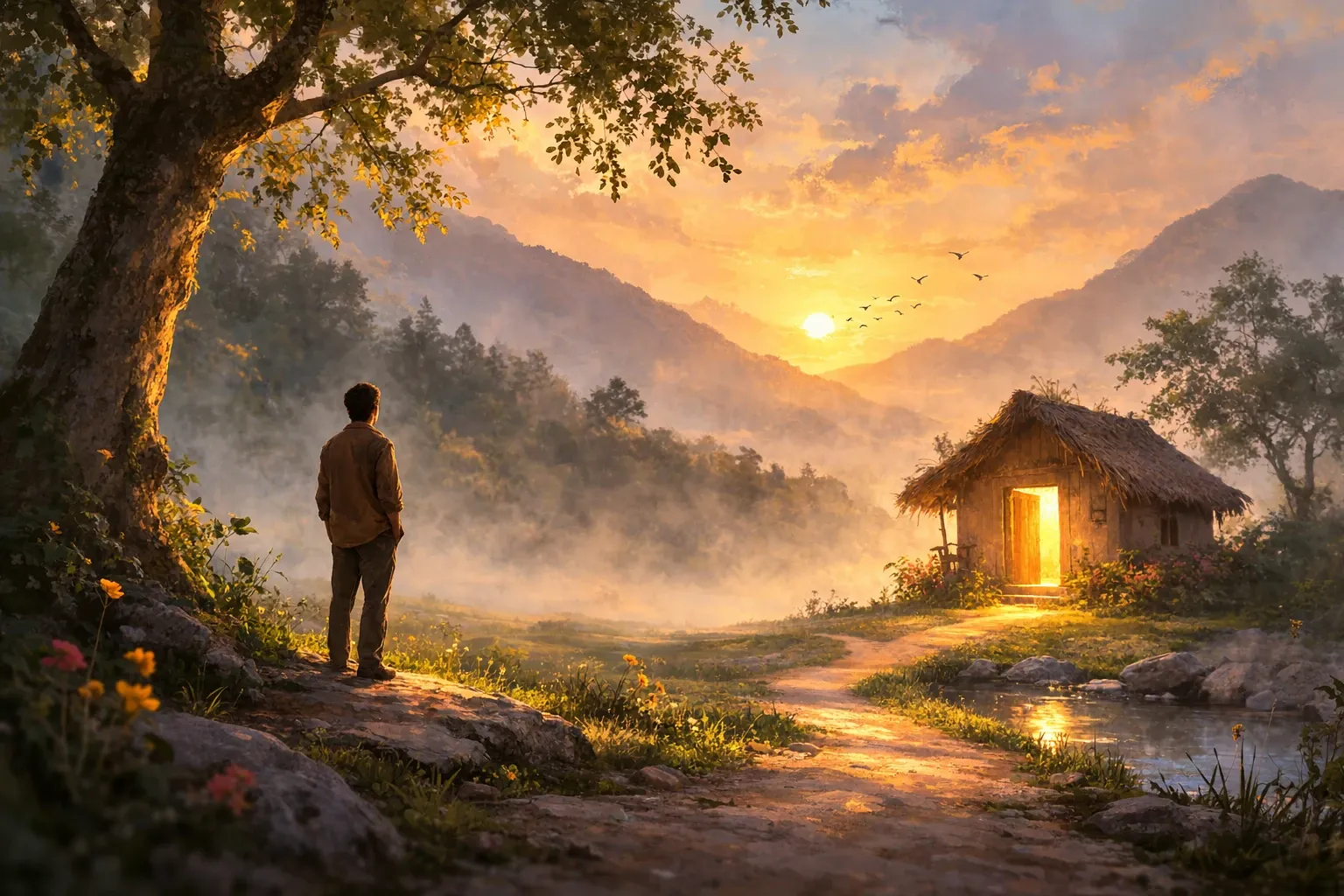
How I Discovered Umbanda: My First Experience in a Umbanda Terreiro
This text tells the story of my first encounter with Umbanda, a Brazilian spiritual tradition with African roots. Today I write from Europe, where many people are still discovering Umbanda for the first time. For me, that journey began in a terreiro in Brazil.

First Impressions
Like almost every Brazilian, I had seen those scenes many times since childhood.
Sometimes at a street corner.
Sometimes near a tree, or at a crossroads.
Candles, flowers, food offerings — sometimes things like farofa, fruit, or drinks.
At the time I knew all of that only by one name — usually used in a dismissive or mocking way: “macumba.”
I had no idea what it actually was.
I didn’t know what it meant.
And to be honest, I had never really stopped to ask.
For many people in Brazil, those scenes are simply part of the landscape — visible, but rarely understood.
Around my mid-twenties I started hearing a little more about these practices. And along with that came something I only recognize clearly today: prejudice.
A quiet kind of prejudice. The kind that people absorb without realizing it.
Over time, in the middle of that prejudice, a small curiosity began to appear. And that was how, one day, I accepted an invitation to visit a terreiro.
A terreiro is the ritual space or spiritual house where Umbanda giras — spiritual sessions — take place.
The First Time I Entered a Terreiro
The first time I stepped into a terreiro of Umbanda was during a celebration dedicated to Ibeji.
In Umbanda, Ibeji is associated with the spiritual line of children — joyful and playful entities that represent innocence and spontaneity. Today I know that these names and symbols carry deep meaning. But at that moment I knew absolutely none of that.
When I arrived, what I saw looked much more like a celebration than anything I had imagined finding in a religious space.
The terreiro was full of happy people.
Many brought sweets.
Others helped prepare the space.
Some decorated the room.
Others organized tables, plates, and drinks.
There was a natural sense of cooperation. Everyone seemed to know exactly what to do.
Everyone except me.
I stood there, a little lost, with a thought repeating in my mind:
“Better not touch anything.”
It was fear mixed with prejudice.
The Beginning of the Ritual
After some time, people began organizing themselves.
That was when I first noticed something I understand much better today: there was a difference between the assistência — the visitors seated there seeking spiritual help or guidance — and the people who had spiritual responsibilities in that house.
The people attending the ceremony were those who had come seeking guidance or spiritual help.
The workers were those who had spiritual roles within that terreiro.
They positioned themselves in the center of the space.
Men on one side, women on the other.
At that moment it felt strange to me.
Today I understand the reasons better, but that night it was simply another detail I didn’t understand.
Then the curtains were closed, and together with the many other people seated there, it was no longer possible to see what was happening in the center of the terreiro.
Prayers began — asking God, the Orishas, and the entities to protect the work of that night.
At one point I heard something that stayed in my memory:
“Laroyê Exu!”
I remember feeling startled.
In my mind a thought appeared immediately:
“Wait… isn’t this the one people say is the devil?”
Later I would learn how deeply mistaken that association is.
The Sound of the Drums
After the prayers, silence filled the room.
Then the atabaques — traditional sacred drums used in Afro-Brazilian religions — began to play.
Everyone started singing together.
And there I was again, completely lost, not knowing whether I should sing, remain silent, or simply observe.
The curtains were still closed, and I could not see what was happening in the center of the terreiro.
Suddenly I heard a powerful shout echoing through the room.
Today I know it was the announcement of a Caboclo, the spiritual leader of the house — a type of entity in Umbanda often associated with the wisdom and symbolic ancestry of Brazil’s Indigenous peoples.
At the time, however, it was simply a series of sounds that made no sense to me.
Then the curtains opened.
I saw several people dressed in white, and one of them standing in the center speaking in a very different way, blessing those present and thanking everyone for being there.
Then he announced that the child entities would come.
An Unexpected Joy
Before the ceremony had begun, someone had tried to explain to me — very briefly — what would happen that night.
When they asked if it was my first time, I answered a little hesitantly:
— “It’s my first time in a terreiro. I don’t really know anything.”
Today I realize that I give almost the same explanation when I take someone to a terreiro for the first time — something I have done many times over the years.
But there is something curious about that.
No explanation really prepares someone for the experience of being there.
At that moment my lack of understanding mixed with something much stronger that seemed to come from everywhere:
a genuine sense of joy.
When the Children Arrived
Then something happened that I absolutely did not expect.
Adults began running across the terreiro.
Some spoke like children.
Others made funny faces, asked for sweets, drank guaraná, a popular Brazilian soft drink made from an Amazonian fruit.
Some were young like me.
Others were old enough to be my grandparents.
And yet everything felt strangely natural.
The children had arrived.
My First Encounter with a Spiritual Entity
Before the consultations began, each “child” — or rather, each medium now incorporating one of the child entities — chose a small place on the floor of the terreiro.
They sat down, spread out small toys, drew symbols on the floor, and in their own particular way seemed to prepare themselves to receive people.
Then the consultations began, and people were called in the order they had arrived.
Eventually my turn came.
Someone asked my name.
— “Hugo.”
Then they said:
— “Hi Hugo, welcome. Today you will speak with Joãozinho.”
Joãozinho was the first Umbanda entity I ever spoke to.
The first thing he said to me was something I will never forget:
— “Hey mister! Do you want some cake?”
Before I could even answer, he grabbed a piece of cake with his hand and placed it straight into my mouth.
It was so unexpected that I simply accepted it.
Then he asked why I was there.
I told him it was my first time and that I was just getting to know Umbanda — a word that still sounded strange to me back then.
Then he said something that stayed with me:
“This is Umbanda.
And you’ll come to know it over time, as you keep coming here.”
At that moment it sounded almost like an invitation.
The Beginning of a Journey
At that moment I had no idea what had just happened.
But that night I had met the medium who would guide the beginning of my entire path within Umbanda — and also Joãozinho, the childlike entity who would be part of that story from the very first encounter.
Without realizing it, a journey had begun.
A journey that continues to this day.
Faith, Religion, and Spiritual Paths
Looking back, I eventually understood something that only became clear with time.
For a long time I already had faith, curiosity, and spiritual questions. But I had not yet found a place where all of that made sense in a concrete way.
Sometimes faith exists before the path.
And when we finally encounter a space where that faith can be lived, something inside us begins to align.
That place may not always be permanent. Spiritual paths evolve, mature, and sometimes lead us elsewhere.
But that does not diminish the importance of the first place where things truly began to make sense.
Because it was there that something which had once been only an intuition started to take form.
Umbanda in Europe
Umbanda was the place where my faith found its first real expression.
The same faith that had once taken shape during childhood in church with my parents and grandparents.
It was also the beginning of many questions, many lessons, and many changes in perspective.
This blog was born from that journey.
Today I write from a particular situation: living and practicing spirituality outside Brazil. I currently live in Germany, a place where Umbanda is still little known and where people rarely encounter it by chance.
Despite this, Umbanda has gradually begun to find its place here — still small, but increasingly visible. Today I know Germans who approached this tradition out of curiosity or through unexpected encounters, practicing alongside people from other countries and even Brazilians who, interestingly, had never had contact with Umbanda before living outside Brazil. Experiences like these reveal something interesting: when a tradition crosses borders, it often ends up being discovered in unexpected ways.
Living this tradition outside Brazil changes how we see it. Things that once felt like a natural part of everyday life begin to look different when viewed from another country, another culture, and another religious landscape.
Part of the purpose of this space is to share those reflections: what it means to carry a Brazilian spiritual tradition into other parts of the world, how it is understood outside Brazil, and how that journey continues to transform over time.
My own path began in Brazil, crossed cultures, traditions, and borders — and today continues here in Europe.
Entre Mundos.
And perhaps that is a good way to begin this conversation.