What I Slowly Learned About the Orishas
What are Orishas? At first, I could barely answer. They appeared in the songs, the rhythms, and the atmosphere of the gira. Only with time did I begin to understand these forces of creation, nature, and life.

Before I Understood the Orishas, I Listened
For a long time, the Orishas reached me before any explanation did.
I heard them in the songs.
I saw their names appear in prayers, conversations, and the spiritual guidance of the house.
At certain moments during the Umbanda gira — the spiritual session held in the terreiro — Caboclo Tupinambá, the entity who guided the terreiro, would ask:
“play for Ogun.”
“play for Oshun.”
“play for Oshala.”
And so it went.
At the time, I did not understand why.
I only sensed that it mattered. It was not just a change in song or rhythm. Something shifted in the atmosphere.
In the terreiro I attended, there were also spaces dedicated to some Orishas. I saw people approach those spaces with respect, listening to guidance, making requests and offerings.
At the time, almost all of this escaped me.
I still did not understand why certain requests were directed to one Orisha and not another. I also did not understand why, at certain moments, the gira seemed to call upon a specific force.
Even so, something in me responded.
Some songs touched me more than others.
Certain names awakened an affinity I could not explain.
Perhaps that was the first way the Orishas came close to me: not as a theory, but as a presence.
For a long time, learning about the Orishas meant trying to answer a silent question:
what are these forces that seem to move through everything?
A Map So I Would Not Get Lost Among the Orishas
When we do not understand something, we often try to organize it.
That is what I did.
I began to create a kind of inner map of the Orishas.
Ogun: paths, iron, strength.
Oshun: rivers, fresh waters, fertility, and love.
Oshala: white, peace, creation.
Shango: stone, thunder, justice.
Yemanja: sea, motherhood.
Oshossi: forest, hunting, knowledge.
Oya: wind, movement, transformation.
Omolu: illness, healing, withdrawal.
These associations helped me.
When we enter a spiritual tradition with its own names, symbols, songs, and stories, it is natural to look for points of reference. A first form of organization helps us recognize a name, remember a color, or associate an Orisha with a force of nature.
But with time, I began to realize that associating an Orisha with a few attributes did not mean I truly understood that Orisha.
It was only a beginning.
To name a force is not the same as knowing it.
A table helps us begin, but what it points toward is always larger.
What Are Orishas in Umbanda?
The question that took longest to mature in me was simple:
what are Orishas?
At first, I already knew some names, colors, and associations with elements of nature.
But I still did not know where the Orishas belonged in Umbanda within my own spiritual understanding.
The Orishas were not Umbanda entities in the way I was beginning to understand entities: spirits who come close, speak, and work through mediums.
They were also not “gods” in the distant sense I knew from other traditions.
Little by little, I began to understand them differently.
In Umbanda, when we speak of Orishas, we are speaking of forces connected to creation, nature, and life itself.
The Orishas represent spiritual principles that manifest in nature and help sustain different aspects of existence.
They speak of the way the world organizes itself, moves, and is sustained.
I came to understand them as primordial forces of creation, expressions of the divine that make certain dimensions of existence more accessible to our perception.
They reveal themselves in rivers, forests, stones, winds, waters, fire, and earth.
They also express themselves in aspects of human experience, such as movement, healing, justice, motherhood, fertility, transformation, knowledge, and peace.
That is why, for me, it was important to understand one thing before anything else:
the Orishas speak first of life itself.
Before trying to explain details or classifications, I had to learn to look at what they express in creation.
Perhaps that is why nature helped me so much.
When I began to look at water, wind, forest, and stone, something came closer.
Not because nature explained everything, but because it gave body to something words alone could not carry.
The Many Orishas and the Forces of Nature
Much later, this understanding gained another layer.
At first, I thought I knew the Orishas.
Or at least the best-known ones.
Ogun.
Oshun.
Oshossi.
Shango.
Yemanja.
Oya.
Oshala.
But as I studied more and spent time with people from different traditions, I realized that my map was much smaller than I had imagined.
New names began to appear.
Nanan.
Oba.
Yewa.
Logun Ede.
Osanyin.
Oshumare.
Obaluaye.
Ibeji.
And many others.
Each name seemed to open a new landscape.
It was also during this period that I encountered names that do not always appear in the most familiar lists of Orishas.
Iku, associated with death.
Onilé, connected to the earth itself.
These presences expanded my understanding.
Creation did not speak only of rivers, forests, winds, and seas.
It also spoke of death and of the ground beneath our feet.
When I began to encounter these stories, I realized something important:
the universe of the Orishas was much larger than any short list.
Larger than the best-known Orishas.
Larger than any table.
I no longer wanted only to know who was who.
I wanted to understand which aspect of life each of these forces helped reveal.
Qualities of Orishas: When Each Force Revealed Depth
After realizing the vastness of this universe, I began to encounter another layer of understanding: the qualities of the Orishas.
Until then, I still looked at each Orisha as a great force associated with certain elements of nature and aspects of life.
But little by little, I began to realize that each of them could also manifest in different ways.
A quality of an Orisha is a specific way in which that force manifests, with its own stories, relationships, and paths.
Ogun, for example, is not only a general idea of path, iron, and strength.
There are qualities of Ogun that express this energy in different ways.
Ogun Xoroque, for example, carries a very particular relationship between Ogun and Eshu.
With Oshossi, something similar happens.
Over time, I came to know names such as Inlé, Ibualama, and Otim, which expanded my perception of this force connected to the forest, hunting, and knowledge.
It was at that moment that I began to see the Orishas in a less rigid way.
The names I had learned remained important.
But they no longer felt like complete definitions.
They were doorways.
The table said “Ogun,” but it did not contain all the paths of Ogun.
It said “Oshun,” but it did not contain all the waters of Oshun.
Each name was already a world.
The Rainbow and the Many Rivers of Oshun
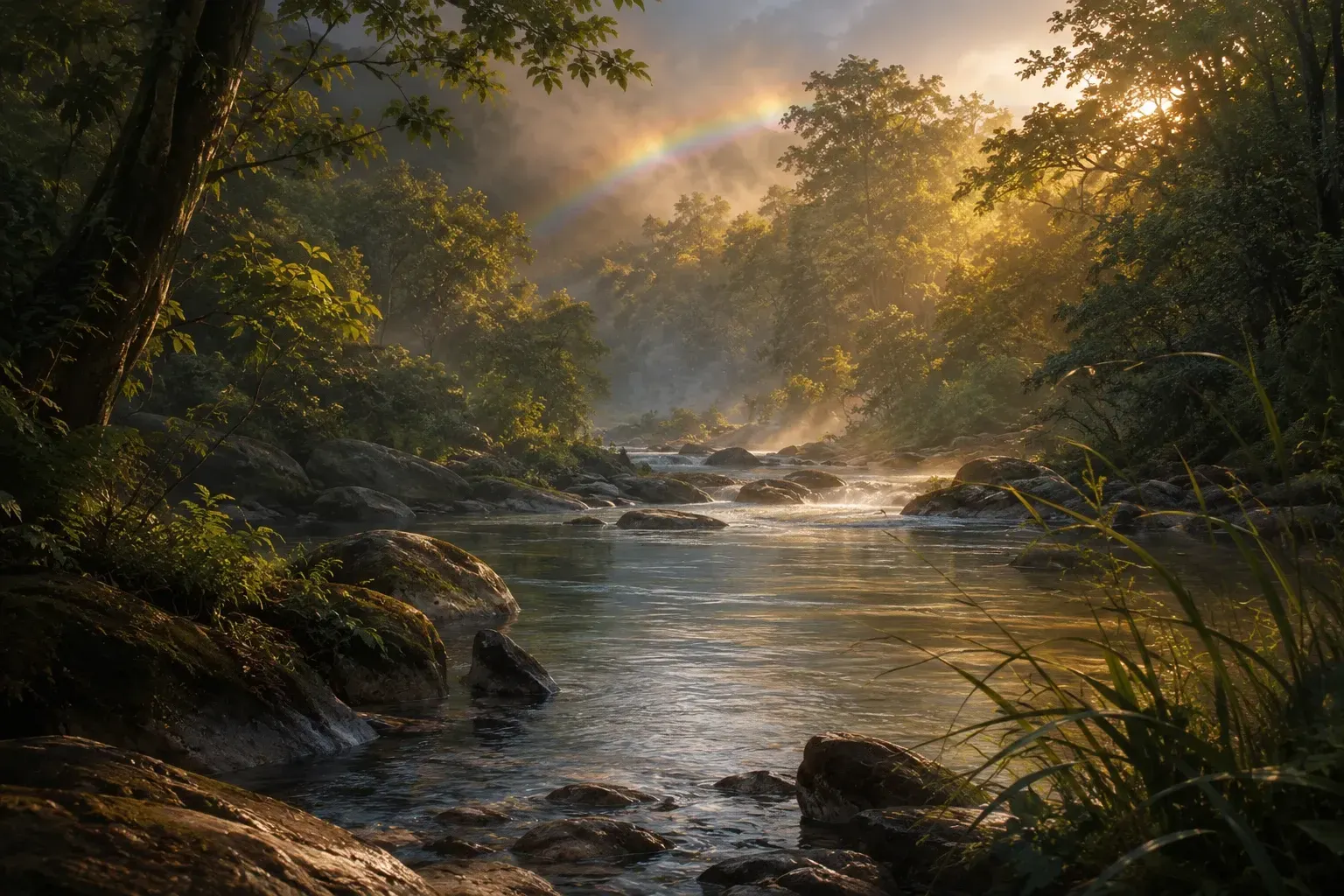
I like to think of the Orishas through the image of a rainbow.
We learn that it has seven colors.
That helps us look, teach, and remember.
But no one who observes a rainbow carefully finds only seven rigid bands.
Between one color and another, there is passage.
There is mixture.
There is an infinity of tones.
Perhaps something similar happens with the Orishas.
We name these forces so we can come closer to them.
But the names do not exhaust the presence.
They help, guide, and open a door.
I think about this often when I look at Oshun.
We often speak of Oshun as the Orisha of rivers, fresh waters, love, and fertility.
But how many rivers exist?
There are wide rivers and narrow ones.
Calm rivers and violent ones.
Transparent rivers and dark ones.
Rivers that curve around stones, overflow their banks, or move hidden through the forest.
If there are so many rivers, perhaps there are also many ways for Oshun to manifest.
An Oshun who welcomes.
Another who protects.
Another who enchants.
Another who teaches boundaries.
When I began to think this way, Oshun stopped being only a set of attributes.
She became a living image.
And a living image never fits entirely into a simple phrase.
The Colors We Learn to See
Today, I still recognize the importance of those first tables.
They helped me organize names, colors, elements of nature, and attributes of the Orishas.
But I do not want to stop there.
Because perhaps the Orishas are indeed like the rainbow.
We learn a few colors so we can begin to look.
But when we come closer with calm attention, we realize there are countless tones between one color and another.
Before any attempt at definition, there were rivers, winds, forests, stones, and paths.
There were the greater forces that sustain life.
Learning about the Orishas, for me, was first learning to look at those forces.
Not only as categories.
But as living presences.
We begin with names.
Then we find images.
Then we perceive paths.
And when we look again, we realize that what once seemed like a table was only the first way of seeing something much larger.
Perhaps that is why it took me so long.
And perhaps it is all right that it did.
Some things do not reveal themselves all at once.
They need to be heard in songs, perceived in the atmosphere of the gira, and recognized in nature.
Felt many times before they are understood.
Entre mundos.
And perhaps some colors only appear when we learn to look more slowly.